

What qualifications do you need to become a personal trainer?
In the UK fitness industry, the standard route is to complete a Level 2 Gym Instructing qualification followed by a Level 3 Personal Training qualification.
Level 2 Gym Instructing prepares you to work with clients in a gym environment. Level 3 Personal Training is the qualification normally expected if you want to work as a personal trainer.
If you are new to the fitness industry, you will usually need to complete Level 2 before progressing to Level 3. Some students complete the qualifications separately, but many now choose a combined Level 2 and Level 3 route.
At Educate Fitness, this is available through our Level 3 Diploma in Fitness Instructing and Personal Training. This route is popular because it gives you a clear pathway from beginner level through to becoming a qualified personal trainer.
What is an awarding organisation?
An awarding organisation is responsible for developing, awarding and quality assuring regulated qualifications.
This matters because you should make sure your personal trainer course leads to a recognised qualification, not just an in-house certificate from a training company.
In England, regulated qualifications are overseen by Ofqual. This helps give students, employers and the fitness industry confidence that the qualification meets recognised standards.
Before enrolling on a personal trainer course, always check the exact qualification title, the awarding organisation and whether the qualification is regulated.
I speak to people regularly who have completed cheap fitness or personal training courses, only to later find that gyms, employers or insurers do not accept the certificate.
Trusted awarding organisations in the fitness sector include Focus Awards, Active IQ, NCFE and YMCA Awards. At Educate Fitness, our personal trainer qualifications are awarded by Focus Awards and regulated by Ofqual.
Qualification trust checks
Before choosing a personal trainer course, check that the provider can clearly confirm:
- The exact qualification you will receive
- The awarding organisation
- Whether the qualification is regulated by Ofqual
- Whether the course is recognised by CIMSPA
- How theory and practical assessments are completed
- What tutor support is included
What is CIMSPA recognition and why does it matter?
CIMSPA is the Chartered Institute for the Management of Sport and Physical Activity. It is the main professional body for the UK sport and physical activity sector.
When comparing personal trainer courses, CIMSPA recognition is one of the key things to check. It shows that the course has been mapped against recognised professional standards for the role.
This is important because employers, gyms and insurers often want to see that your qualification is recognised within the fitness industry.
Educate Fitness is a CIMSPA Education Partner and CIMSPA Training Provider Partner. We have also achieved CIMSPA’s highest 3-Star “Enhancing” quality assurance rating, which gives students additional confidence that our learning, support, systems and delivery have been externally reviewed against sector expectations.
You can read more about what this means here: Educate Fitness achieves CIMSPA 3-Star Enhancing rating.
How do training providers get recognised?
Training providers do not simply decide for themselves that a course is recognised. They have to go through a quality assurance process.
This can include submitting course materials, assessment guidance, tutor information, policies, procedures and evidence that the course follows the required qualification standards.
For students, the key point is simple: do not rely only on a provider saying their course is ‘recognised’. Ask who awards the qualification, whether it is regulated by Ofqual, and whether the course is recognised by CIMSPA.
How long does it take to become a personal trainer?
The time it takes to become a personal trainer depends on the type of course you choose, your previous experience and how much time you can commit each week.
Some face-to-face courses run over a fixed schedule, such as several weeks of classroom and gym-based learning. These can suit students who want a set timetable and regular in-person contact.
Online and distance learning courses are usually more flexible. At Educate Fitness, students have up to 2 years to complete their course, although many complete much sooner.
We have had students complete in only a few months, while others take longer because they are studying around work, family or other commitments.
The important thing is to choose a course that gives you enough structure, support and time to complete properly, rather than rushing through the qualification.
Online, face-to-face or blended: which personal trainer course is best?
The best type of personal trainer course depends on your learning style, confidence, schedule and practical experience.
Some students prefer face-to-face learning because they want more direct contact with a tutor. Others prefer online learning because they need to study around work, family or other commitments.
The key is not simply whether the course is online or face-to-face. The key is whether the course is recognised, well structured, properly assessed and supported by real tutors.
Face-to-face personal trainer courses
Face-to-face personal trainer courses require you to attend set training days in person. This can be useful if you prefer a fixed timetable, direct tutor contact and practical coaching in a gym environment.
You will normally know the course dates in advance, which can make it easier to plan your study time and assessment deadlines.
Face-to-face courses can also be useful for building confidence, practising exercise technique and meeting other students who are working towards the same goal.
The main downside is flexibility. If you work shifts, have family commitments or cannot travel easily, a fixed timetable may be harder to manage.
Online personal trainer courses
Online personal trainer courses can be a good option if you need flexibility. They allow you to study around work, family, training and other commitments, rather than attending fixed classroom dates.
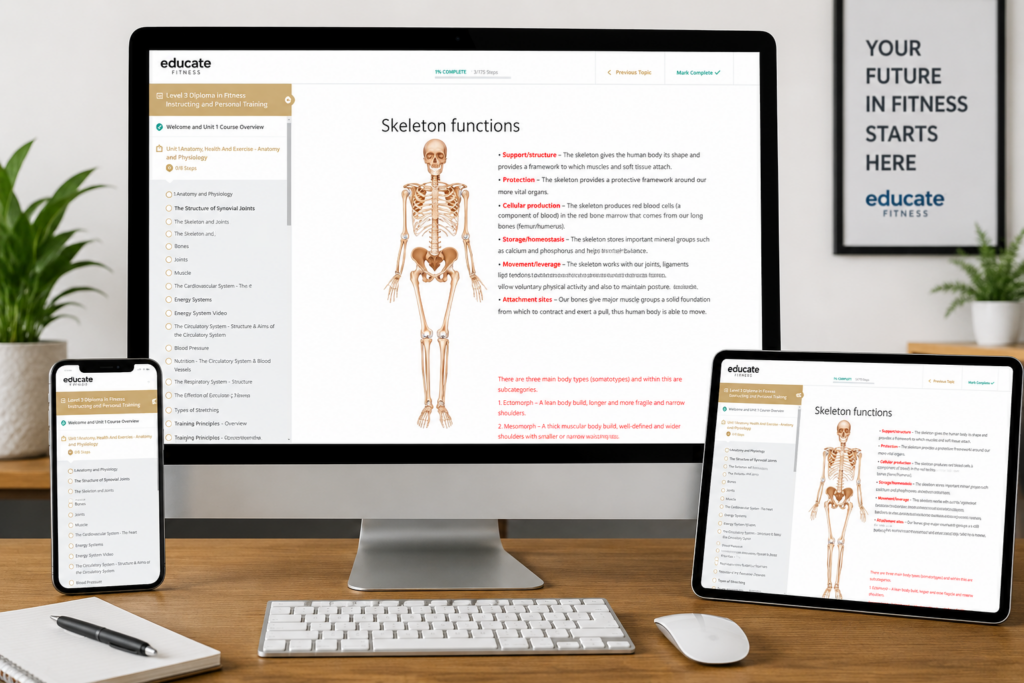
When you enrol on an Educate Fitness online personal trainer course, you are given access to our eLearning system. The course is split into lessons and topics, so you can work through the content in a clear order and return to key areas when you need to revise.
Lessons include videos, presentations and written course materials to help you understand the subject properly. This is important because personal training is not just about passing assessments. You need to understand anatomy, exercise technique, programme design, client support, health screening and safe coaching practice.
Online students are also allocated tutor support. If you are struggling with a topic, assessment question or practical requirement, you can contact your tutor for guidance.
Our online students also have access to live tutor-led webinars. These sessions help break down key topics from the course and give students the chance to ask questions. If you cannot attend live, recorded webinars are available through the eLearning system.
The main benefit of online learning is flexibility. The important thing is to choose an online course that still gives you structure, tutor support and a clear practical assessment process.
How are personal trainer courses assessed?
A recognised personal trainer course should assess both theory knowledge and practical coaching skills.
The theory side may be assessed through exams, coursework, online tests or a combination of methods, depending on the qualification and provider.
At Educate Fitness, we use coursework and assessments to check understanding, rather than relying only on a final written exam. This allows tutors to identify where a student may need more support and give feedback before the work is signed off.
This approach is useful because the goal is not just to help students gain a certificate. The goal is to help students develop the knowledge, confidence and practical skills needed to work safely and effectively with clients.
The practical assessment is also important. Personal training is a practical profession, so students need to demonstrate that they can plan, instruct and evaluate real exercise sessions.
If you are studying online, make sure the provider clearly explains how practical assessments work. You should know what evidence is required, where the assessment can take place, who marks it and whether there are any additional fees.
At Educate Fitness, online students can complete practical assessments in a suitable gym environment and submit the required evidence for tutor marking.
Once all theory and practical assessments have been completed and passed, you can achieve your personal training qualification.
How much does a personal trainer course cost?
Personal trainer course prices vary depending on the qualification, delivery method, tutor support, assessment process and what is included.
Very low-cost courses should be checked carefully. A cheap course may look attractive at first, but it is important to confirm exactly what qualification you will receive, who awards it, whether it is regulated, whether it is recognised by CIMSPA, and whether practical assessments or resits cost extra.
As a general guide, recognised personal trainer courses can vary from several hundred pounds to over £2,000, depending on whether the course is online, blended or face-to-face.
When comparing prices, do not only look at the headline cost. Check what support is included, how assessments work, whether you receive tutor feedback, how long you have access to the course and whether there are any hidden fees.
How do I know if a personal trainer course is good value?
Price does not always reflect quality. Some expensive courses offer limited support, while some lower-cost options may still be suitable if they lead to the right qualification and include proper tutor guidance.
Before enrolling, check independent reviews and look beyond the overall star rating. Read the 1-star and 2-star reviews as well as the positive ones. This can help you understand what students were unhappy about and whether the provider responds professionally.
Also check what is included in the course fee. A course may look cheaper at first but become more expensive if you have to pay extra for assessments, resits, certificates, tutor support or extensions.
A good personal trainer course should be clear about the qualification, awarding organisation, CIMSPA recognition, tutor support, assessment process, payment options and any additional costs.
How can I pay for a personal trainer course?
Most personal trainer course providers offer either a one-off payment or a payment plan.
A one-off payment may include a discount, but a payment plan can make the course more manageable by spreading the cost over monthly instalments.
Before choosing a payment option, check the total amount payable, the monthly payment amount, whether there are any admin fees and what happens if you need extra time to complete the course.
Are free personal trainer courses worth it?
Be very careful with free personal trainer courses.
Some free resources can be useful for learning, but they are not the same as completing a recognised qualification. If your goal is to work as a personal trainer, you need to check whether the course leads to a regulated qualification and whether it is recognised within the fitness industry.
Before signing up, ask:
- What qualification will I receive?
- Who is the awarding organisation?
- Is the qualification regulated by Ofqual?
- Is the course recognised by CIMSPA?
- How are practical assessments completed?
- Are there any hidden fees?
If a course seems too good to be true, check the details carefully before committing.
Will a personal trainer course help me get a job?
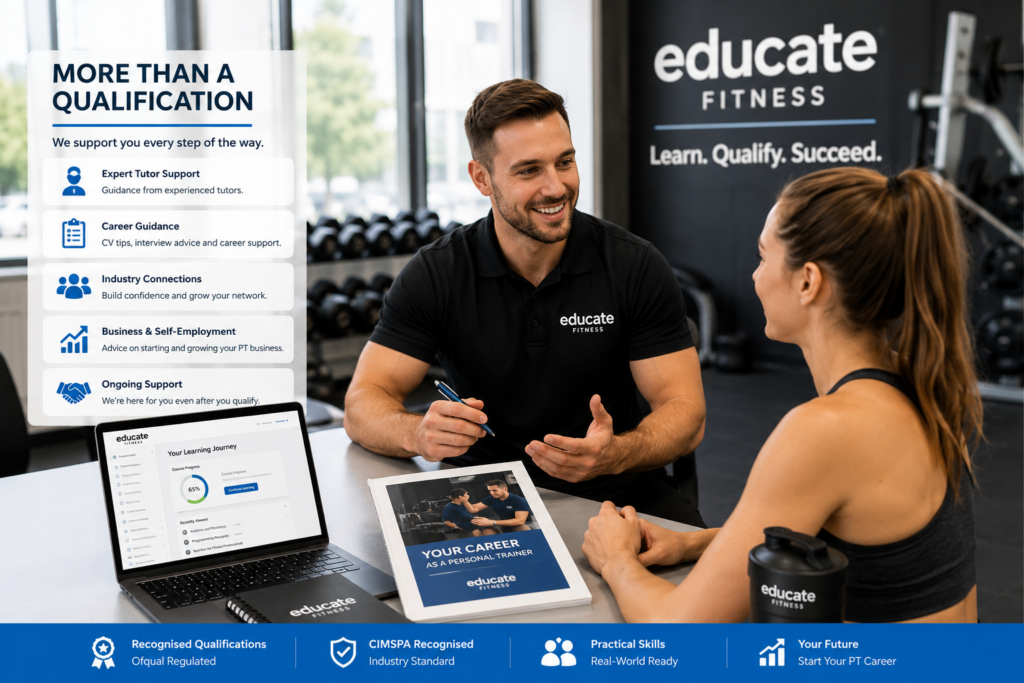
A good personal trainer course should do more than help you pass assessments. It should also help you understand how to start working in the fitness industry.
This may include guidance on applying for gym roles, preparing for interviews, writing a fitness CV, understanding self-employment and building confidence with clients.
There are opportunities in the fitness industry, but employers still want to see that you are reliable, professional and properly qualified. Choosing a recognised course with strong tutor support can help you prepare for that next step.
Red flags when choosing a personal trainer course
Most training providers are trying to help students make the right decision, but there are still some red flags to watch for when comparing personal trainer courses.
Here are the main warning signs to look out for before you enrol.
Pressure to enrol immediately
Be cautious if a provider is putting heavy pressure on you to enrol immediately.
A genuine offer or deadline is not automatically a problem, but you should still have time to check the qualification, awarding organisation, CIMSPA recognition, assessment process, reviews and fees before paying.
If the conversation is focused more on the discount than the course itself, take a step back and ask for the key details in writing.
Claims that one awarding organisation is ‘better’ than all the others
Some providers may suggest that their awarding organisation is the only one that employers want.
In reality, the main thing is to check that the qualification is regulated, awarded by a recognised awarding organisation and recognised by CIMSPA.
Do not be distracted by vague claims about one qualification being ‘better’ unless the provider can clearly explain why, and provide evidence.
Free bonus courses that distract from the main qualification
Some providers include free bonus courses, such as nutrition or CPD courses, as part of the sales offer.
This is not automatically a bad thing, but the main qualification should still be your priority. Before being influenced by free extras, ask what level the bonus courses are, who awards them, whether they are regulated, and whether they are genuinely useful for your career.
As part of a Level 3 Personal Training qualification, you should already cover relevant principles of nutrition. A bonus nutrition course may still be useful, but it should not distract from checking the quality and recognition of the main personal trainer qualification.
Vague answers about the course itself
If you ask a direct question about the course, you should receive a clear answer.
Before enrolling, make sure you understand:
- The exact qualification title
- The awarding organisation
- Whether the qualification is regulated by Ofqual
- Whether the course is recognised by CIMSPA
- How the course is delivered
- How tutor support works
- How theory and practical assessments are completed
- Whether there are any extra fees
If a provider cannot answer these questions clearly, that is a warning sign.
Unclear practical assessment requirements
Be careful with any course that does not clearly explain how the practical assessment works.
Personal training is a practical role, so a recognised course should include an assessment process where you demonstrate your ability to plan, instruct and evaluate exercise sessions.
Online learning can work very well, especially for students who need flexibility. However, the practical assessment process still needs to be clear, robust and suitable for the qualification.
Before enrolling, ask exactly how the practical assessments are completed, who marks them, what evidence is required, whether the assessment must take place in a gym environment and whether there are any extra assessment fees.
Quick checklist before you enrol
- Is the qualification regulated?
- Who is the awarding organisation?
- Is the course recognised by CIMSPA?
- Does the provider explain the practical assessment clearly?
- Will you receive tutor support?
- Are all fees explained upfront?
Personal trainer course FAQs
What is the best personal trainer course in the UK?
The best personal trainer course is one that leads to a recognised qualification, is awarded by a reputable awarding organisation, is regulated by Ofqual, is recognised by CIMSPA, includes clear practical assessment guidance and provides proper tutor support.
Do I need Level 2 before Level 3 Personal Training?
In most cases, yes. Level 2 Gym Instructing is normally completed before Level 3 Personal Training. If you are new to the fitness industry, a combined Level 2 and Level 3 Personal Training Diploma is usually the most direct route.
Can I become a personal trainer with an online course?
Yes, but the course still needs a suitable practical assessment process. Online learning can be a good option if you need flexibility, but you should always check how practical assessments are completed, marked and quality assured.
Is CIMSPA recognition important?
Yes. CIMSPA recognition helps show that the course has been mapped against recognised professional standards for the sport and physical activity sector.
How long does it take to become a personal trainer?
This depends on your experience, confidence and weekly study time. Some learners complete in a few months, while others take longer because they are studying around work, family or other commitments.
How much does a personal trainer course cost?
Personal trainer course costs vary depending on the qualification, delivery method, tutor support and assessment process. Very cheap courses should be checked carefully, especially if the awarding organisation, CIMSPA recognition, practical assessment process or extra fees are unclear.
Final advice before choosing a personal trainer course
Choosing the best personal trainer course is not just about finding the cheapest option or the quickest route.
You should look for a recognised qualification, a reputable awarding organisation, CIMSPA recognition, clear assessment guidance, strong tutor support and transparent pricing.
Before enrolling, make sure you understand exactly what qualification you will receive, how the course is assessed, how much support is included and whether there are any extra fees.
At Educate Fitness, we help students work towards recognised personal trainer qualifications with structured online learning, tutor support and clear assessment guidance.
We are also a CIMSPA Education Partner and CIMSPA Training Provider Partner, with CIMSPA’s highest 3-Star “Enhancing” quality assurance rating. That means our education and training provision has been externally reviewed against sector expectations, giving students added confidence when choosing where to train.
If you are unsure which route is right for you, call us on 0203 794 9250 or complete the form below to speak to a programme advisor.